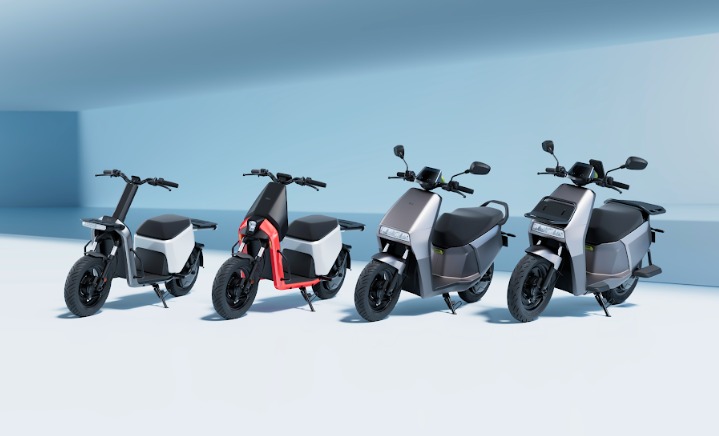
India Electric Scooter Market Outlook
IMARC Group's latest research report on the India Electric Scooter Market provides a comprehensive forecast of the industry's size, share, and emerging trends from 2026 to 2034. It offers an in-depth analysis across various drives, batteries, products, battery fittings, end uses, and regions, covering all critical metrics of the country's electric two-wheeler mobility ecosystem.
How Big is the Electric Scooter Market in India?
The India electric scooter market outlook indicates that the market was valued at USD 1.46 Billion in 2025 and is projected to reach USD 3.32 Billion by 2034, expanding at a CAGR of 9.22% during 2026–2034. The India electric scooter market growth is anchored by Phase-II of the FAME Scheme with an outlay of Rs. 10,000 Crore supporting 10 lakh e-2 wheelers by 2024, rising petrol prices driving TCO superiority of EVs, PLI scheme-driven domestic battery manufacturing, and India's ambitious EV penetration targets.
Emerging Trends in the India Electric Scooter Market:
Vertical Integration and In-House Battery Cell Manufacturing:
Ola Electric's Cell Technologies Gigafactory, India's first 4680 cylindrical cell Gigafactory for EV 2-wheelers, represents the most strategically significant development in India's EV scooter industry since the FAME II scheme. This vertical integration strategy eliminates import dependency on Chinese Li-ion cells and delivers cost advantage per scooter, fundamentally reshaping the competitive economics of India's EV scooter market. The PLI Advanced Chemistry Cell scheme targets 50 GWh domestic manufacturing capacity, progressively reducing import dependency and cell costs. As domestic cell production scales, the upfront cost premium between EV and ICE scooters is expected to narrow significantly, making EV adoption economically compelling for mass-market consumers.
Battery Swapping as a Charging Alternative for Apartment Dwellers:
India's dense urban apartment culture creates a structural charging barrier that battery swapping uniquely addresses. This model demonstrates the disruptive pricing model that swappable EV scooters enable versus fixed-battery alternatives, particularly for consumers in apartment buildings where dedicated charging infrastructure is unavailable. Battery swapping reduces upfront purchase costs by separating battery ownership from vehicle ownership while eliminating charging time concerns. The expansion of battery swapping networks by major OEMs and specialized operators is creating a parallel range solution for consumers unwilling to wait for charging, addressing one of the most significant barriers to EV adoption in urban India.
EV Scooter Premium Segment Premiumization and Performance Race:
India's premium EV scooter segment is experiencing a performance escalation unprecedented in India's 2-wheeler history. This performance superiority is becoming the premium EV scooter segment's primary appeal for affluent urban consumers who previously owned performance ICE scooters. Manufacturers are competing on acceleration, top speed, range, and connected features, with premium models delivering specifications that rival or exceed comparable ICE scooters. The premiumization trend is also driving innovation in battery technology, motor efficiency, and software capabilities that eventually cascade down to mass-market models, accelerating the overall technology trajectory of India's EV scooter industry.
➤ Request Sample Report with Datasheet – TOC, Charts & Key Insights: https://www.imarcgroup.com/india-electric-scooters-market/requestsample
Growth Factors Driving the India Electric Scooter Market:
FAME II and EMPS 2024 Subsidies Reducing EV Purchase Cost:
The Ministry of Heavy Industries' FAME II (Faster Adoption and Manufacturing of Hybrid and Electric Vehicles) Phase II scheme set up over 2,877 EV charging stations across 25 states, creating foundational infrastructure for EV adoption. These subsidies have been instrumental in bridging the upfront cost gap between EV and ICE scooters, making electric two-wheelers accessible to a broader consumer base. The transition from FAME II to EMPS 2024 demonstrates the government's sustained commitment to EV adoption, with the INR 10,000 per vehicle incentive under EMPS 2024 continuing to support purchase decisions. As the subsidy model progressively shifts toward manufacturing competitiveness support, the industry is expected to achieve self-sustaining growth driven by economics rather than incentives.
Rising Petrol Prices and 60-80% Lower Running Cost vs ICE Scooters:
India's average petrol retail price of INR 100–107 per litre creates a stark cost differential versus EV scooters' INR 0.15–0.25 per km electricity cost. This 60-80% lower running cost translates into significant annual savings for high-mileage users, particularly gig economy delivery workers who cover 100+ km daily. The total cost of ownership advantage is approaching or has already achieved breakeven versus equivalent ICE scooters on a 3-4 year ownership cost basis in urban high-mileage use cases. As petrol prices remain elevated and electricity costs remain comparatively stable, the economic case for EV scooter adoption continues to strengthen across consumer segments.
PLI Scheme Driving Domestic Li-ion Cell and Component Manufacturing:
India's Production-Linked Incentive (PLI) Scheme for Advanced Chemistry Cell Battery Storage with an INR 18,100 crore outlay and PLI Scheme for Automobile and Auto Components with an INR 25,938 crore outlay collectively fund the most critical supply chain dependency India's EV industry must resolve: its near-total reliance on Chinese Li-ion cell imports. These schemes are attracting significant investment in domestic cell manufacturing, motor production, and component localization, progressively reducing import dependency and improving cost competitiveness. As domestic manufacturing scales, the EV scooter industry is expected to benefit from lower input costs, improved supply chain resilience, and reduced exposure to geopolitical supply risks and currency volatility.
Industry Value Chain Analysis:
Component and Raw Material Supply: Lithium-ion cell suppliers, Indian cell manufacturers under PLI, PMSM/BLDC motor manufacturers, permanent magnet suppliers, and battery management system suppliers form the upstream base of the value chain.
EV Scooter Manufacturers (OEMs): Ola Electric Mobility Ltd., TVS Motor Company, Bajaj Auto Ltd., Ather Energy, and Greaves Electric Mobility Limited lead domestic manufacturing across facilities concentrated in Tamil Nadu, Karnataka, and Maharashtra.
Dealers and Distribution: Dedicated EV dealer networks, e-commerce direct sales, exclusive brand showrooms, traditional ICE dealer EV transition, and fleet procurement channels connect products to end users.
Charging and Battery Infrastructure: Home charging solutions, Ather Grid public fast-charging network, Ola Hypercharger network, and Tata Power EV charging infrastructure support vehicle operation across urban and semi-urban markets.
End Users and Regulators: Personal commuters, delivery/logistics fleet operators, and e-mobility aggregators represent end users, while MoRTH, MHI, BIS, and State RTOs provide regulatory oversight and policy support.
Market Segmentation Analysis
IMARC Group's latest research report on the India Electric Scooter Market categorizes the market based on drive, battery, product, battery fitting, end use, and region.
By Drive
Hub motors lead at 42.8% in 2025 as the dominant drive system for India's high-volume mass-market EV scooter segment. Hub motor's key advantage, integration of motor, reduction gear, and brake drum within the wheel hub eliminating frame-mounted motor, chain/belt transmission, and associated maintenance, delivers the lowest total cost of ownership for India's urban commuter. Belt drive at 34.6% captures the aspirational premium segment where TVS, Bajaj, and Ather compete on performance, range, and brand prestige. Chain drive at 22.6% maintains presence in the budget segment and rural markets where chain drive's field-repairable design and lowest manufacturing cost extend market access to areas beyond OEM service network reach.
By Battery
Lithium-ion dominates at 86.5%, having displaced lead-acid through a combination of regulatory mandate (FAME II subsidy eligibility requiring Li-ion), consumer preference for 100+ km range that only Li-ion enables, and rapidly declining Li-ion pack prices. Lead acid at 10.8% persists in the ultra-budget EV scooter segment serving India's most price-constrained consumers in Tier-3 cities, Tier-4 towns, and rural markets where a 40-60 km range is sufficient for daily needs. Others at 2.7% encompasses sodium-ion prototypes at the pilot stage, nickel-metal hydride (NiMH) in legacy models, and hybrid solid-state Li-ion in the R&D phase.
By Product
Standard scooters lead at 72.5% in 2025, representing the mainstream consumer preference for conventional designs that balance performance, comfort, and price. Folding, self-balancing, maxi, and three-wheeled variants serve niche applications including last-mile connectivity, personal mobility for differently-abled users, and specialized commercial use cases.
By Battery Fitting
Fixed battery configurations lead at 76.0% in 2025, as most consumers prefer the simplicity and lower upfront cost of integrated battery designs. Detachable battery configurations at 24.0% are gaining traction among apartment dwellers and consumers without dedicated parking charging access, enabling battery charging at home or office while the vehicle remains parked.
By End Use
Personal use dominates at 75.5% in 2025, driven by individual commuters seeking economical daily transportation. Commercial applications at 24.5% are growing rapidly as gig economy delivery platforms including Zomato, Swiggy, and BigBasket commit to 100% EV fleet conversion, creating a captive high-volume demand segment.
By Region
South India leads at 32.5% in 2025, with Tamil Nadu hosting India's densest EV manufacturing cluster including Ola Electric's Future Factory, TVS Company (Hosur), Ather Energy (Hosur), and others, creating co-location advantages where proximity to manufacturing reduces logistics cost and enables rapid dealer network servicing. North India at 26.4% benefits from Delhi NCR's extreme air quality crisis creating India's most policy-driven EV push. West India at 22.1% reflects Maharashtra's EV Policy 2021, India's most financially generous state EV subsidy creating Mumbai and Pune's outperforming EV adoption. East India at 19.0% represents the fastest-growing region at approximately 10.5% CAGR, driven by Kolkata's historically high dependency on traditional cycle-rickshaws and e-rickshaws creating the foundation for electric 2-wheeler adoption normalisation.
Competitive Landscape & Key Player Positioning:
India's electric scooter market exhibits high concentration among the top-3 manufacturers: Ola Electric, TVS Motor Company, and Bajaj Auto Chetak collectively commanding 58-72% of India's EV scooter market revenue by value. Including Ather Energy creates a top-4 accounting for 75-85% of industry revenue by value, with Ather's premium price point contributing 15-20% of revenue from 10-15% of volume.
Key players include:
Ola Electric Mobility Ltd.
TVS Motor Company
Bajaj Auto Ltd.
Ather Energy
Greaves Electric Mobility Limited
Latest Recent Developments in the India Electric Scooter Market:
Ola Electric Launches S1 X+ with 5.2 kWh Battery Pack (April 2026): Ola Electric launched its new S1 X+ electric scooter with a 5.2 kWh battery pack, priced at an introductory INR 1,29,999, expanding its mass-market portfolio with improved range and performance specifications.
TVS Motor Company Launches Orbiter V1 Under BaaS Model (March 2026): TVS Motor Company launched the Orbiter V1 electric scooter, pricing it from ₹49,999 under a new Battery-as-a-Service (BaaS) model, making EV scooter ownership accessible at a significantly lower upfront cost by separating battery ownership from vehicle ownership.
Bajaj Auto Launches Chetak C25 Electric Scooter (January 2026): Bajaj Auto launched its brand-new Chetak C25 electric scooter with a neo-tribe vibe, sleek design, and new look, expanding its Chetak portfolio to compete more effectively in the volume segment.
Customization Note: If you require any specific information not covered within this report's scope, we will provide it as part of the customization.
Frequently Asked Questions (FAQs)
Q1. What is the current size of India's electric scooter market?
The India electric scooter market was valued at USD 1.46 Billion in 2025.
Q2. What is the CAGR for India's electric scooter market (2026-2034)?
The India electric scooter market is forecast to grow at a CAGR of 9.22% during 2026-2034, reaching USD 3.32 Billion by 2034.
Q3. Which drive type leads India's electric scooter market?
Hub Motors lead with 42.8% revenue share in 2025, driven by hub motor's lower manufacturing cost enabling competitive pricing at the mass-market segment where Ola S1 X and Ampere lead volume.
Q4. Which region leads India's electric scooter market?
South India leads with 32.5% revenue share in 2025, anchored by Tamil Nadu and Karnataka's EV manufacturing cluster hosting Ola Electric, Ather Energy, TVS Motor, and Ampere Vehicles.
Q5. What are the key factors driving the India electric scooter market?
Key drivers include FAME II/EMPS 2024 subsidies reducing purchase cost, rising petrol prices creating high annual EV running cost savings, PLI Scheme domestic cell manufacturing scaling, expanding Ather Grid/Ola Hypercharger charging networks, and gig economy commercial fleet conversion. Key trends include Ola Cell Technologies' 4680 Gigafactory cell production, software-defined connected platforms, battery swapping, belt drive premium segment growth, women consumers as fastest-growing buyer segment, and commercial fleet EV conversion.