 India Perfume Market Outlook
According to latest research report by IMARC Group, the report titled "India Perfume Market Size, Share, Trends and Forecast by Perfume Type, End User, Distribution Channel, Top States and Companies Analysis, 2026–2034" comprises a comprehensive analysis of the Indian market, covering its size, growth trends, key drivers, regional insights, and other critical metrics defining the country's fragrance and personal grooming ecosystem.
How Big is the Perfume Market in India?
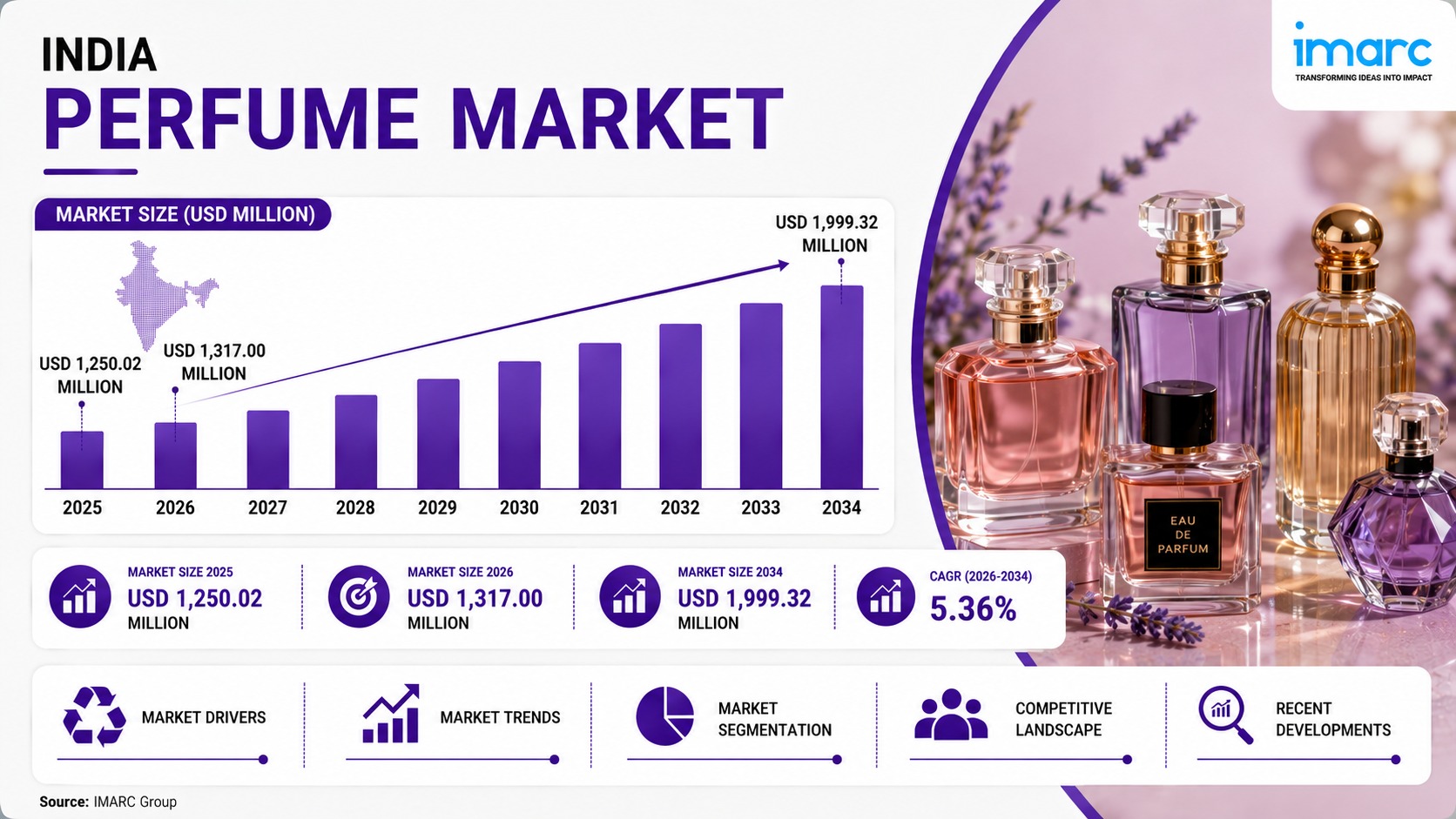
The India perfume market outlook indicates that the market size reached USD 1,250.02 Million in 2025 and is projected to reach USD 1,999.32 Million by 2034, growing at a CAGR of 5.36% during 2026–2034. The India perfume market growth is driven by rising disposable incomes, a large and style-conscious youth population, growing demand for premium and everyday fragrance products, increasing urbanization, expansion of organized retail, and rapid growth of online fragrance sales.
Emerging Trends in the India Perfume Market:
Premiumization and the Rise of Signature Scents:
The Indian fragrance market is witnessing a decisive shift toward premium and luxury fragrances, with consumers increasingly viewing perfumes as tools for personal branding rather than simple odor control. Premium perfumes dominate with a 58% market share in 2025, driven by rising aspirational demand, growing brand consciousness, and an expanding gifting culture during weddings and festive seasons . Modern buyers are moving beyond basic deodorant use toward curated scent wardrobes, layering oils with sprays and matching fragrance to mood, time of day, or setting. This shift is particularly pronounced among urban millennials and Gen Z consumers who treat fragrance as an extension of personal style .
Digital-First Brands Reshaping Market Dynamics:
The competitive environment is becoming less concentrated, with the leader steadily losing ground from 19% in 2020 to 16% value share in 2025, reflecting both the rapid emergence of digital-first brands and the expansion of established players across new retail and pricing formats . Brands like Bella Vita have accelerated share gains through aggressive digital strategies, while startups such as Fraganote and Secret Alchemist have raised seed funding to scale operations . Online perfume sales in India have risen 25-30% in the last year, with brands heavily investing in trial kits, miniatures, and influencer-led marketing to reduce purchase hesitation and encourage digital sampling .
Growing Demand for Natural, Clean, and Gender-Neutral Fragrances:
There is a surging demand for traditional attars, alcohol-free formulations, and customized gender-neutral fragrances as consumers become more conscious of ingredients and environmental impact . The market has seen a 30% rise in search interest for gender-neutral scents, challenging traditional product categories . Unilever Ventures' investment in Secret Alchemist—a clean perfume brand focused on transparent, wellness-led formulations and aromatherapy-inspired scents—signals growing institutional confidence in this premiumisation shift . Local brands are successfully building on cultural heritage, offering fragrance oils, mists, and traditional perfumes without losing cultural connection .
Growth Factors Driving the India Perfume Market:
Rising Disposable Incomes and Urbanization:
The India perfume market is primarily driven by rising disposable income and urbanization, which are allowing consumers to spend more on personal care and luxury goods . As economic development extends beyond metropolitan areas into tier-II and tier-III cities, the addressable consumer base for fragrances expands significantly. The emergence of more affordable luxury divides has allowed consumers from middle-income classes to experience premium fragrances, vastly expanding the overall customer base . Increased awareness of personal grooming and hygiene is further influencing demand, particularly among the younger generation who view fragrance as an essential part of daily grooming routines.
Expansion of Organized Retail and E-Commerce:
The rapid expansion of organized retail through luxury malls, duty-free channels, and platforms like Nykaa is democratizing the fragrance experience across tier-II cities . Nykaa Perfumery stores are already generating three times the average order value of regular stores, with more than 45% of sales coming from men's fragrance, suggesting an expanding consumer base . The growth of e-commerce websites is creating strong opportunities as online channels make available easy access to varied perfumes from local and international brands . This omnichannel expansion is reducing purchase hesitation and making discovery more accessible.
Celebrity Endorsements and Social Media Influence:
The impact of celebrity endorsement and social media is remaking the market, with brands using digital space to appeal to younger generations and build aspirational appeal . French luxury brand Azzaro appointed Ibrahim Ali Khan as Fragrance Local Ambassador for India, Ajmal Perfumes roped in Saif Ali Khan, while Ranbir Kapoor's premium lifestyle brand ARKS sells unisex premium perfumes . Social media platforms are fundamentally changing how consumers make decisions, enabling brands to educate consumers about notes, routines, and fragrance wardrobes while creating aspirational appeal that drives adoption across demographics.
Industry Value Chain Analysis:
Raw Material and Essence Supply: Suppliers provide natural and synthetic fragrance compounds, essential oils, and alcohol bases, with growing emphasis on sustainable and ethically sourced ingredients including Indian-origin materials like agarwood from Assam and traditional attar ingredients from Kannauj.
Perfume Manufacturing and Formulation: Manufacturers blend fragrance compounds into finished products across concentration levels including eau de toilette, eau de parfum, and perfume oils, with increasing investment in research and development for long-lasting formulations suited to India's climate.
Brand Development and Marketing: Companies invest in brand creation, celebrity partnerships, digital marketing campaigns, and influencer collaborations to build aspirational appeal, particularly targeting younger consumers through social media platforms.
Distribution and Retail: Products reach consumers through offline channels including department stores, cosmetic stores, malls, and duty-free outlets, alongside rapidly growing online platforms, quick commerce, and D2C brand websites.
Consumer Engagement and After-Sales: Brands provide discovery kits, sampling programs, and personalized consultation services, with digital platforms enabling AI-driven scent profiling to help consumers navigate complex olfactory choices.
Deep-Dive Segment Insights
By Perfume Type: Premium perfumes dominate with a 58% market share in 2025, driven by rising aspirational demand, growing brand consciousness, and an expanding gifting culture. The mass segment continues to serve price-sensitive consumers across tier-II and tier-III cities .
By End User: Female consumers lead with a 52% market share in 2025, supported by higher spending on personal grooming and evolving lifestyle trends. The unisex fragrance segment is expanding rapidly, while men's fragrances represent the single largest product segment according to Euromonitor, with 45-50% of sales at some retailers coming from male consumers .
By Region: North India commands the top position with a 31% market share in 2025, fueled by major metropolitan centers like Delhi-NCR, higher per capita expenditure, and robust premium retail infrastructure. Maharashtra ranks as one of the largest state markets, driven by Mumbai and Pune's cosmopolitan culture and entertainment industry influence .
Competitive Landscape & Key Player Positioning:
Covering an in-depth analysis of the competitive landscape, market structure, key player positioning, competitive dashboards, top winning strategies, and detailed profiles of all major industry participants you will gain access to all these exclusive insights within the full research report.
Latest Recent Developments in the India Perfume Market:
Unilever Ventures Invests in Secret Alchemist (Early 2026): Unilever Ventures made a strategic investment in Secret Alchemist, a clean perfume brand focused on transparent, wellness-led formulations and aromatherapy-inspired scents. The brand raised approximately USD 3 million in seed funding, with additional participation from DSG Consumer Partners, to expand its fragrance portfolio, strengthen research and development, and scale distribution across e-commerce and quick commerce platforms .
INTERPARFUMS Partners with Global SS Beauty Brands for India Expansion (2026): Global SS Beauty Brands Limited (GSSBB), a subsidiary of Shoppers Stop Limited, entered into an exclusive strategic partnership with INTERPARFUMS SA to distribute, develop, and build its portfolio of prestige fragrance brands in India. The partnership brings together INTERPARFUMS' portfolio including Coach, Montblanc, Jimmy Choo, Lacoste, and Van Cleef & Arpels with GSSBB's understanding of the Indian luxury beauty and retail landscape .
Nykaa Launches Dedicated Perfumery Retail Format (February 2026): Nykaa launched Nykaa Perfumery, a fragrance-only retail format, opening two locations in Mumbai featuring export-led consultations, discovery tables, and an assisted discovery tool. The stores are already generating three times the average order value of regular Nykaa stores, with more than 45% of sales coming from men's fragrance .
Customization Note: If you require any specific information not covered within this report's scope, we will provide it as part of the customization.
Frequently Asked Questions (FAQs)
Q1. What is the current size of India's perfume market?
India's perfume market size reached USD 1,250.02 Million in 2025 .
Q2. What is the CAGR for India's perfume market (2026-2034)?
India's perfume market grows at a 5.36% CAGR during 2026-2034, reaching USD 1,999.32 Million by 2034 .
Q3. Which perfume type leads India's perfume market?
Premium perfumes dominate with a 58% market share in 2025, driven by rising aspirational demand, growing brand consciousness, and an expanding gifting culture .
Q4. Which end user leads India's perfume market?
Female consumers lead with a 52% market share in 2025, supported by higher spending on personal grooming. The unisex fragrance segment is also expanding rapidly .
Q5. What are the key factors driving the India perfume market?
The growth of the India perfume market is driven by rising disposable incomes, a large and style-conscious youth population, growing demand for premium and everyday fragrance products, increasing urbanization, expansion of organized retail, the strong influence of social media and celebrity culture, and rapid growth of online fragrance sales .